Measured bidirectional texture functions (BTFs) capture the full appearance of real materials—including parallax, self-shadowing and inter-reflections that analytic SVBRDFs cannot express—but each measurement is billions of values, and every new material requires a new capture. Existing neural BTF representations encode each material as large per-texel latent maps rather than as a point in a shared space from which new materials could be sampled.
We present neural representations of measured BTFs at two operating points. A per-material coordinate network outperforms the recent neural BTF of Xia et al. at matched size (+3.2 dB PSNR) and all prior baselines on every metric. A compact model represents each material by a single 256-dimensional code that conditions a shared decoder; it exceeds the PSNR (+1.2 dB) and colour accuracy of the per-texel latent maps of Rainer et al. with 256 numbers per material instead of millions, and one decoder shared by all materials.
Because each material is a single point in this code space, measured BTFs can be sampled: a class-conditional flow over the codes, trained on the 84 materials enlarged with colourways and hue rotations, generates materials that render and relight as full BTFs.
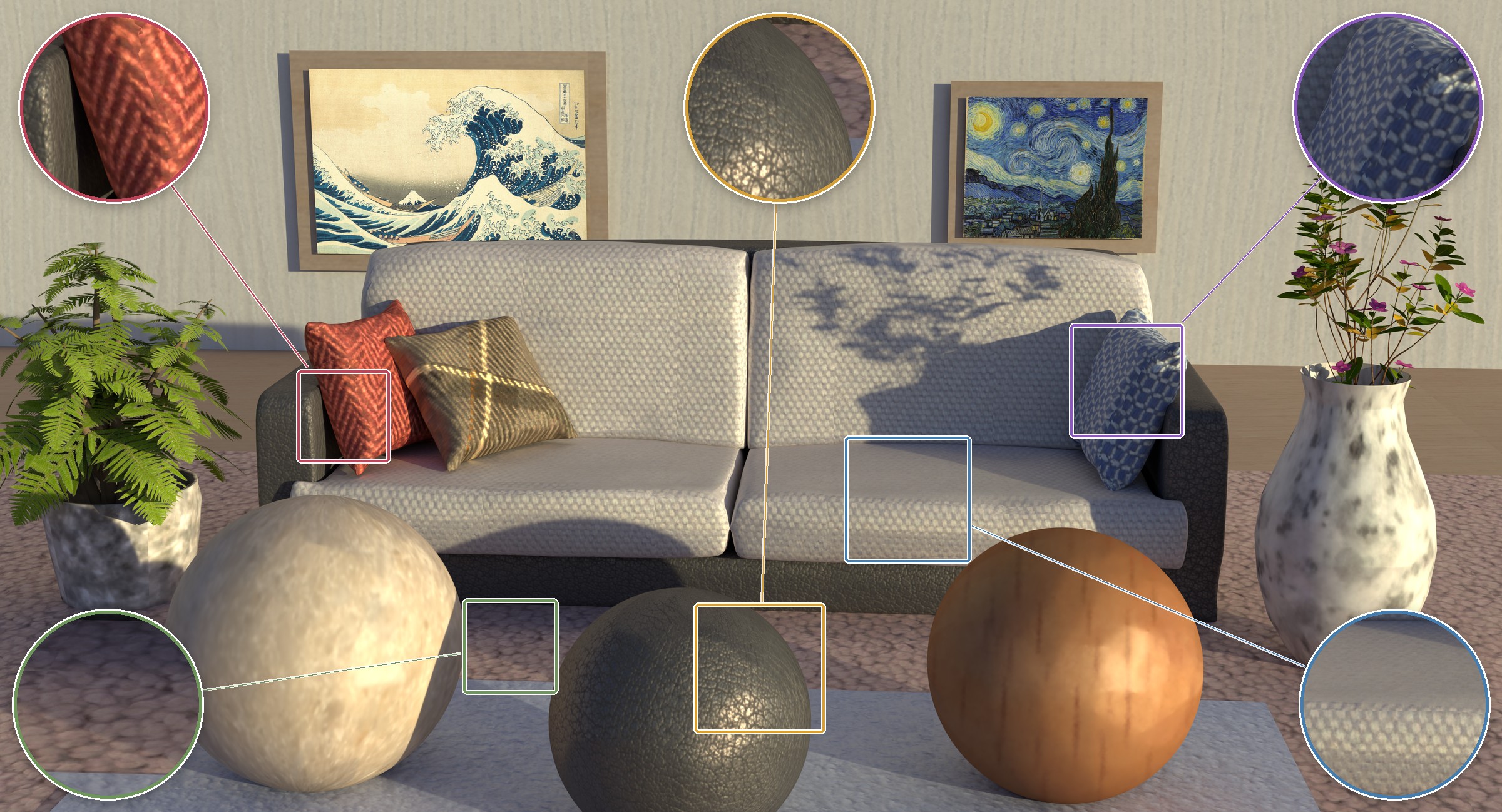
Measured materials, each represented by a single code and decoded as a full BTF, rendered on objects with Mitsuba 3 under an outdoor environment map; the teal teapot is a hue rotation of carpet05 from our augmented dataset. Click an image for the full-resolution render.
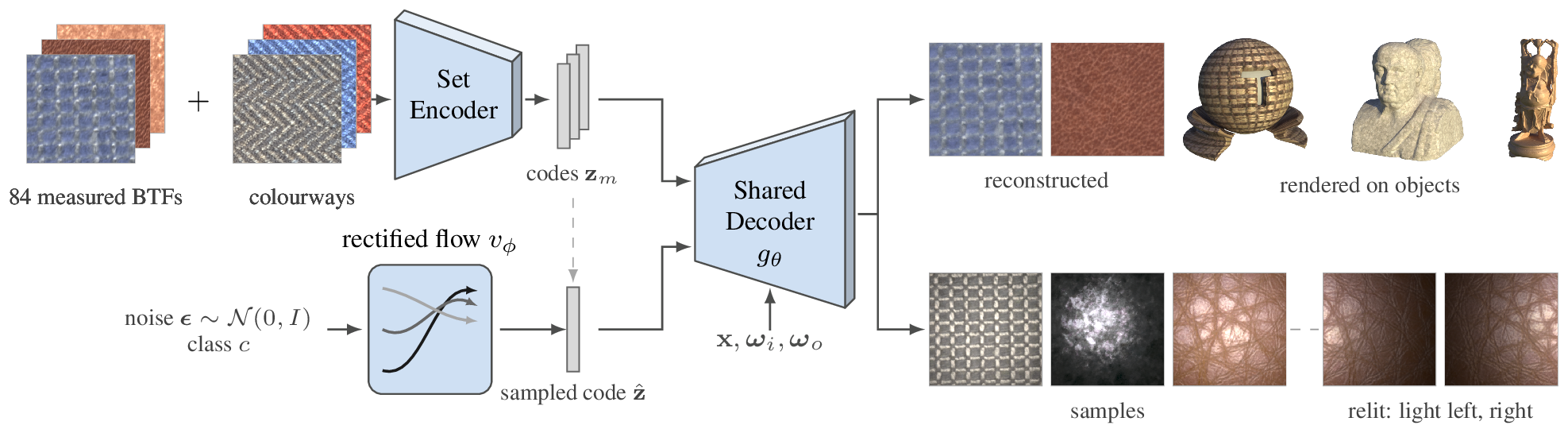
The compact model encodes each measured material and its colourways into one 256-float code with a set encoder; a decoder shared by all materials maps the code, texel position and light and view directions to RGB. A class-conditional rectified flow fitted to these codes samples new codes, which the same decoder renders as full BTFs that can be relit. Top right: measured materials reconstructed by the compact model, rendered on objects.
Pick a material, a light–view pair and a method. Drag across the image to compare it with the measured BTF.
Nine UBO2014 materials at eight light–view pairs of the measured set; one exposure per material, the same for every method. PSNR of this image against the measured image.
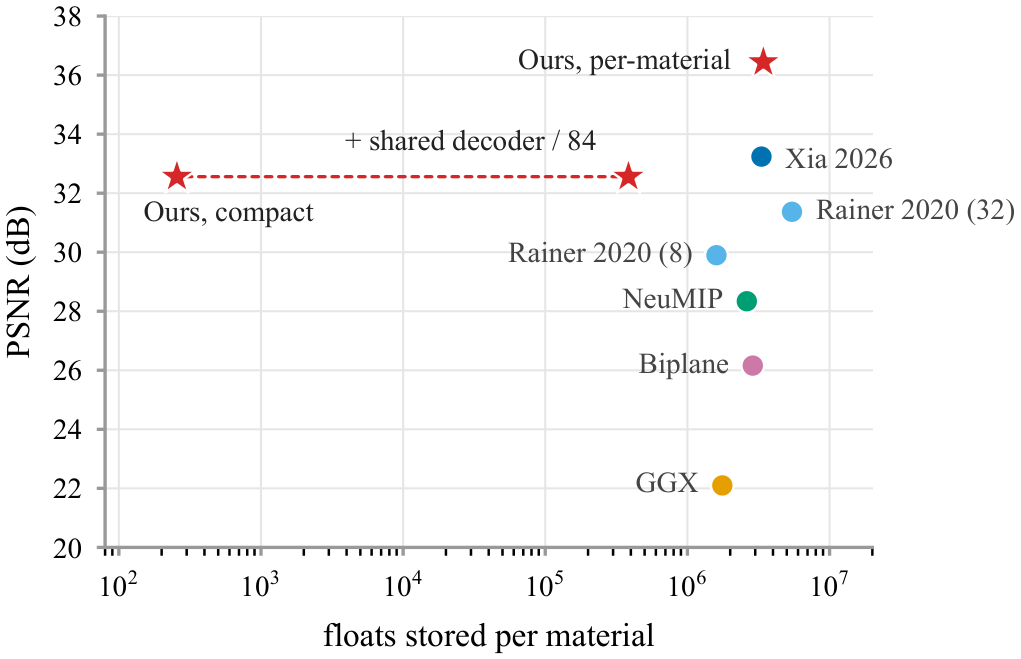
Rate–distortion on the nine materials: PSNR against the number of values stored per material. The compact model is shown with its 256-float code and with the shared decoder amortised over 84 materials.
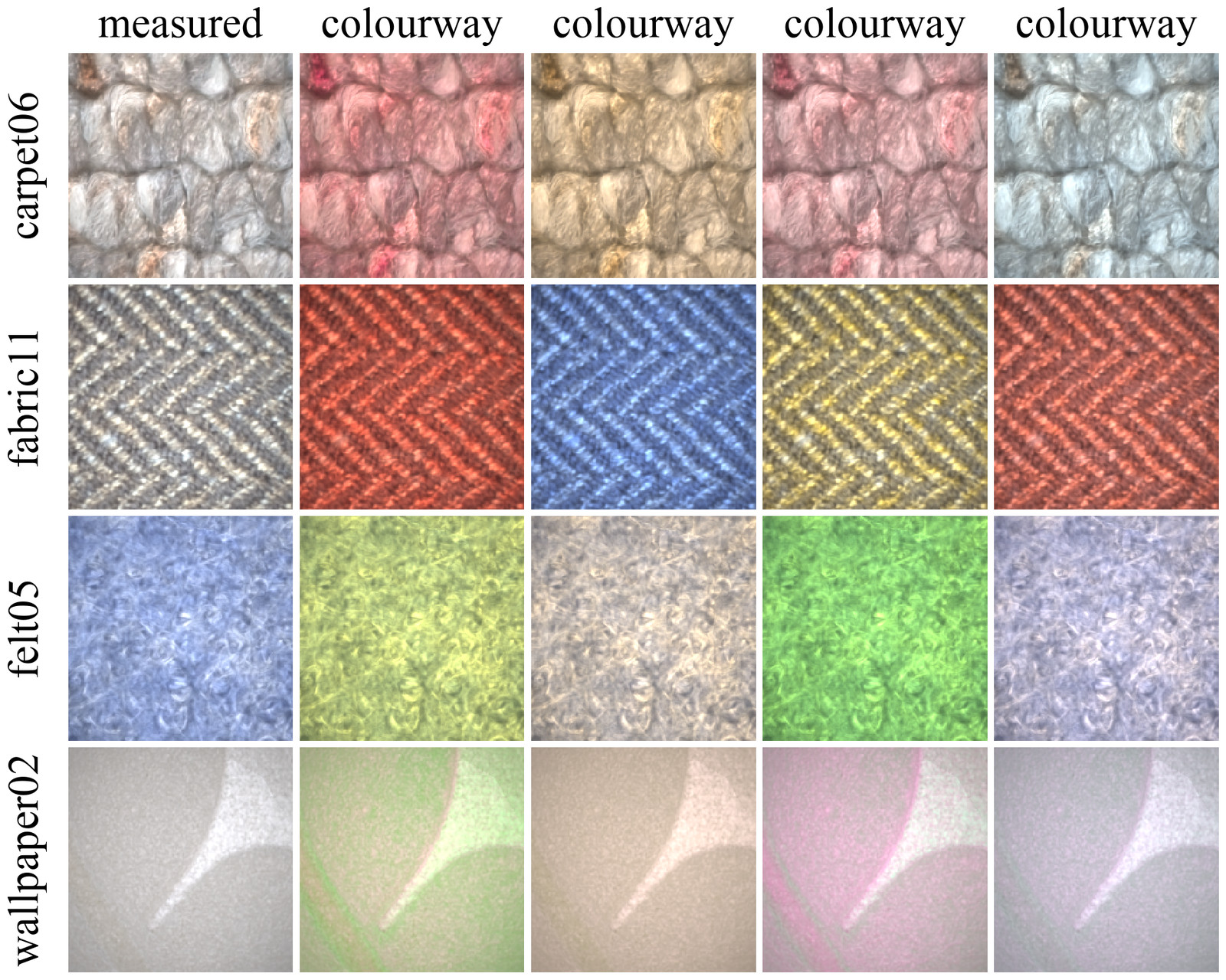
One measured material per row (left) and four of its colourways: its structure in the colours of other materials of its class, as flash photographs. Every value is a measured value under one 3×3 colour transform, so the colourways keep the structure, relief and shadowing of the measured BTFs.
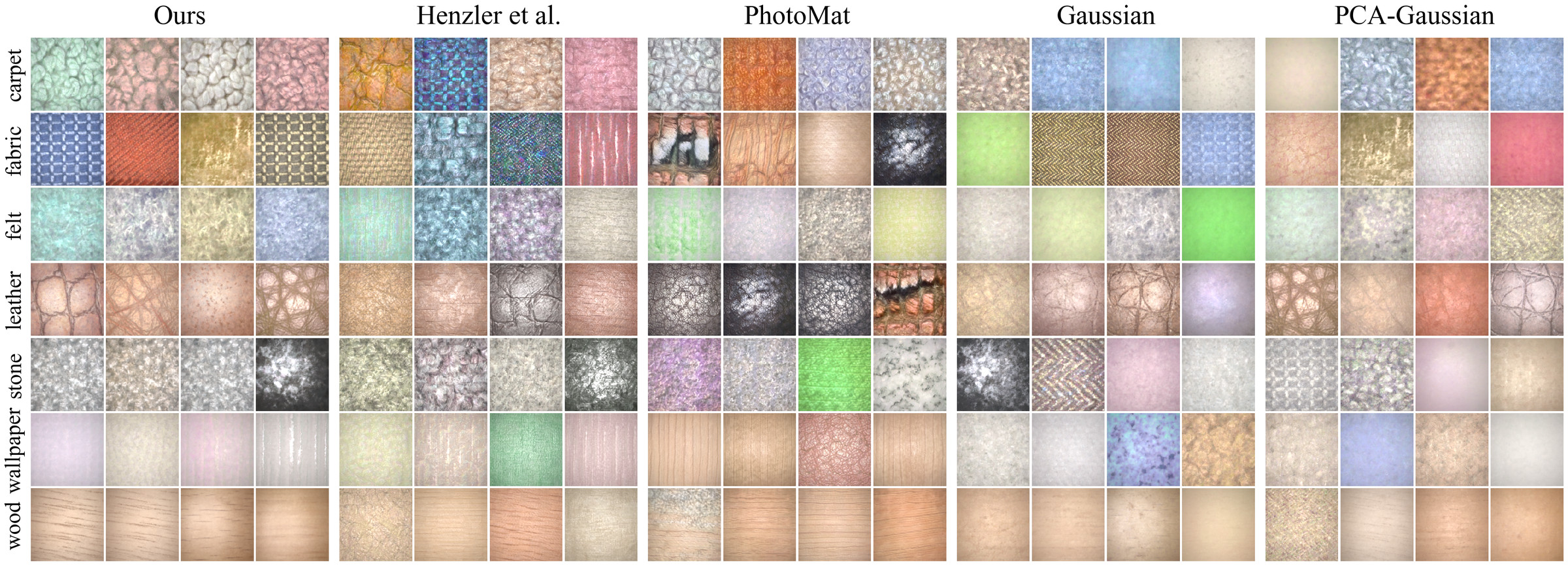
Sampled materials as flash photographs: four random samples per class of each generator, without selection. The Gaussian baselines sample our code space and are decoded by our decoder; Henzler et al. and PhotoMat are retrained or fine-tuned on the same 886 training materials.
Every sample is a full BTF. Move the light with the slider.
Two random samples per class of our generator, camera fixed, lit by a moving point light.
@article{gokbudak2026onecode,
  title   = {One Code per Material: Neural Representation and Generation of Measured BTFs},
  author  = {Fazilet Gokbudak and Canberk Baykal and Chenliang Zhou and Rafal Mantiuk and Cengiz Oztireli},
  journal = {arXiv preprint arXiv:2611.20948},
  year    = {2026}
}